
Industrial strength, commercial quality
Epoxy Floors
About This Service
Epoxy floor coatings transform concrete surfaces into durable, attractive, easy-to-clean floors. Miller's installs epoxy in garages, warehouses, commercial kitchens, auto shops, and industrial facilities throughout East Tennessee. Our epoxy systems are chemical-resistant, slip-resistant, and available in a variety of colors and finishes including solid colors, metallic, and decorative flake.
Why Choose Miller's?
- Extremely durable — resists chemicals, oil, and abrasion
- Easy to clean and maintain
- Available in solid colors, metallic, and decorative flake finishes
- Slip-resistant options available
- Transforms dull concrete into an attractive surface
What is metallic epoxy flooring?
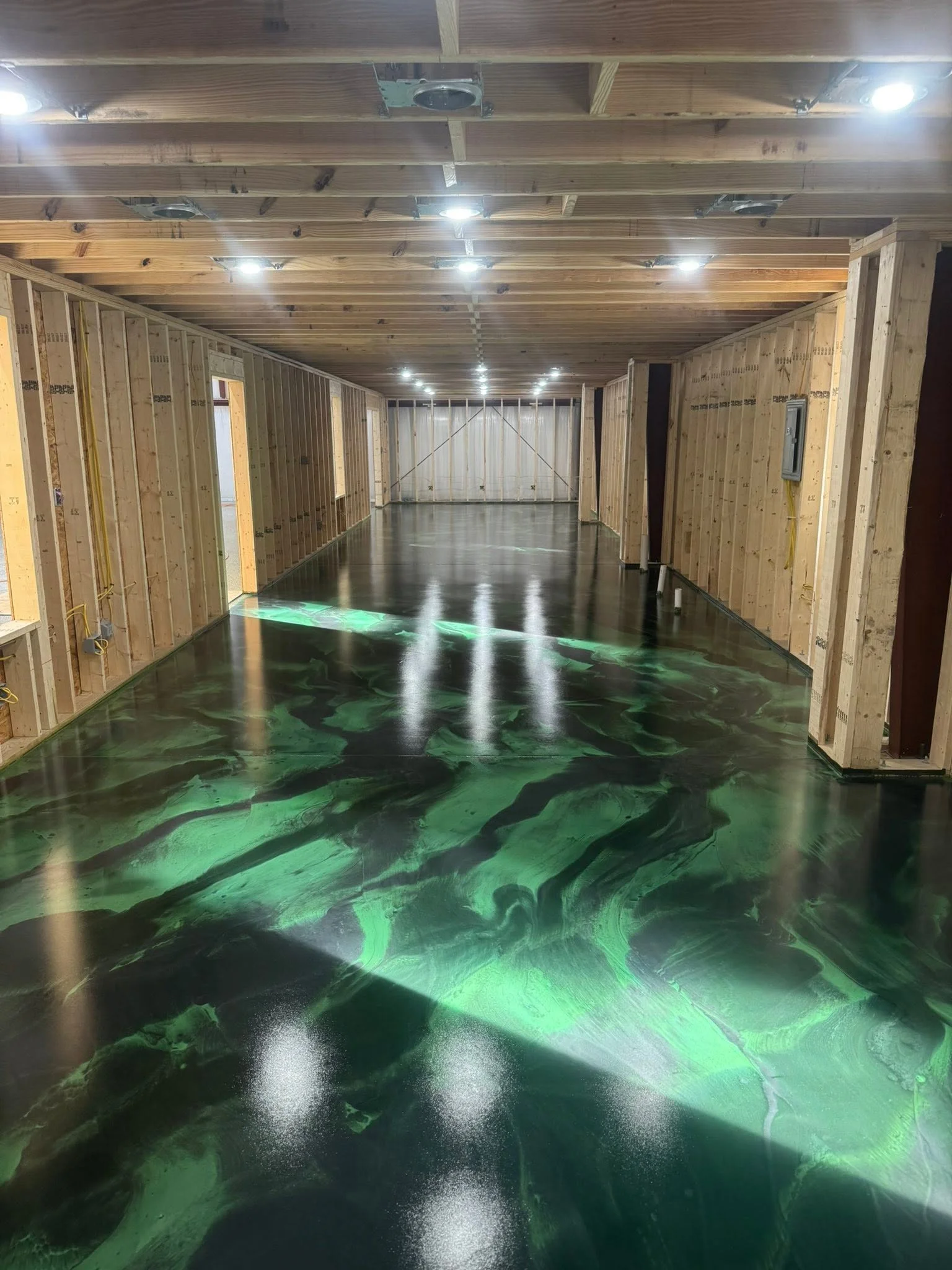
Metallic epoxy is a poured resin floor with reflective pigment mixed in. As it cures, that pigment moves and pools, and the movement is what gives the floor its depth: it reads like you are looking down into water, but it is flat, seamless, and hard. No two metallic floors come out the same. We can steer the color and the amount of movement. We cannot duplicate a pattern, and that is the point of the finish.
Metallic is the epoxy people choose when the floor is meant to be looked at: a showroom, a shop lobby, a finished garage. Colors can be blended for a subtle marble look or something far more dramatic, and the high-gloss topcoat is what makes the pattern look wet, like the Englewood floor in the video above. The Murphy warehouse in the story below went deep emerald green over black.
What is flake epoxy flooring?
Flake epoxy is a solid-color base coat with decorative vinyl flakes broadcast into it, then sealed under a clear topcoat. The flakes give the floor a speckled texture and a little visual grain. It is the more practical of the two: the texture hides everyday dust and tire marks better than a glossy metallic does, and the look is more uniform, so it suits a working space.
We install flake as often as people ask for it. Flake belongs in garages, workshops, utility rooms, and commercial back-of-house areas, and the color blends run from near-solid to a full terrazzo look. One honest scheduling note: flake is harder to install in cold weather, so a garage floor in the dead of winter may wait for a warmer stretch. We would rather tell you that up front than pour it on a bad day.
Metallic or flake: which epoxy floor should you choose?
Choose metallic for the room people look at, and flake for the room people work in. That one sentence settles most of the conversations we have about it.
- Metallic: flowing, one-of-a-kind pattern. Flake: uniform, speckled texture.
- Metallic: for when appearance is the priority. Flake: for practical, high-use spaces.
- Metallic: a smooth surface that shows dust and tire marks. Flake: texture that hides them.
- Metallic: a statement floor. Flake: an understated one.
Metallic runs more per square foot than flake or a solid-color coating, because of the extra pigment layers and the hands-on time during the pour. For a garage that gets parked in every day, that premium usually is not worth paying. Buy the flake. For a space that customers walk into, the metallic earns its price the first time somebody stops to take a picture of it.
Where can epoxy flooring be used?
Anywhere with a sound concrete slab and a reason to want it seamless: garages, workshops, retail floors, showrooms, shops, breweries and restaurants, gyms, basements, and commercial kitchens and corridors. It is a coating, so it uses the slab you already have. No demolition, no subfloor, no waiting on material to arrive.
Those are examples, not a promise that every epoxy system suits every room. A metallic floor is a decorative system. It handles foot traffic, carts, and rolling loads well, but a forklift lane or a spot that takes dropped tools all day wants a heavier industrial coating in that zone. Plenty of buildings run both, and we will tell you which parts of yours want which. Outdoors, a standard epoxy yellows in sunlight, so a patio or loading dock gets a UV-stable system instead.
A recent metallic epoxy project
The video above is a floor we finished recently in Englewood, in McMinn County: a dark metallic pour with bronze and gold moving through black, sealed under a high-gloss topcoat.
For a second look at what the finish does in a big commercial space, read about the emerald green warehouse floor we poured in Murphy, NC. Every other photo of our epoxy work is in the project gallery.
What to expect from an epoxy installation
Four steps, and the second one decides whether the floor lasts.
- Estimate. We come look at the slab and talk through the finish you want. We do not quote epoxy over the phone from a square footage, because the concrete tells us what the job actually costs. Cracks, old sealer, and moisture in the slab all change the answer.
- Surface preparation. The concrete is mechanically ground to open it up, repaired where it needs it, and checked for moisture. Skipped prep is where nearly every failed epoxy floor we have been called to look at was lost.
- Installation. The base coat goes down, then the metallic pour or the flake broadcast, then the clear topcoat that takes the actual wear.
- Cure. The floor needs time before it goes back to normal use, and heavier loads wait longer. How long depends on the system you choose, so we will tell you when it is ready rather than print a number here.
Most jobs run about two and a half days from the first grind to the finished topcoat. The way we put it at the counter: doing epoxy is like baking an expensive cake. Do one thing wrong, or do one thing too much, and the whole thing can come out wrong. That is why the prep gets more of our time than the pour does.
Is epoxy the right floor for your space?
Not always, and we would rather say so up front. Inside a finished living space, most people are happier with a floor that is warm underfoot and quiet, which usually means luxury vinyl plank or hardwood. In a bathroom with a shower we steer people to tile. A high-gloss epoxy is slick when it is wet, the same as polished tile, so an entry or a wash bay gets a slip-resistant additive built into the topcoat, and we will tell you when a room calls for it.
Where it is right, it is very right: a seamless surface with nowhere for oil, water, or dirt to hide, that cleans with a dust mop and does not need to be replaced every few years. Most of the epoxy we install goes into garages and commercial spaces around Madisonville, Athens, and Maryville.
Tell us about the space, and we will help you decide whether metallic, flake, or a different floor altogether makes the most sense. Request a free estimate or stop by the showroom in Madisonville.
What customers say
Miller's Wholesale Flooring is finishing up on a large commercial job for our office. Excellent work and attention to detail. Highly recommend.
Paula
Excerpts from our Google reviews. Read all of them on Google.
Frequently Asked Questions
How long does epoxy installation take?
Most garage floors take 2–3 days: one day for surface preparation, one for application, and one for curing. Commercial projects vary based on size.
Can epoxy be applied over existing concrete?
Yes, but proper surface preparation is critical. We grind or shot-blast the concrete to ensure proper adhesion.
How long does epoxy last?
A properly installed epoxy floor can last 10–20 years or more with routine maintenance.
Keep reading
Get a Free Estimate
Ready to get started? Call us or fill out our contact form for a free, no-obligation estimate.
(423) 442-1697Request Estimate OnlineAfter hours? Request an estimate online any time and we'll call you back during business hours.
Two-year workmanship warranty. Our own installers do the work.
📍 433 Isbill Road, Madisonville, TN 37354
🕐 Mon–Fri: 9:00 AM – 5:00 PM
Saturday–Sunday: Closed